
We’re proud to welcome The Sensory Safe Solution to Advanced Addiction Center on Tuesday, October 27. Kate Owens-Heins and Rocco Danieli are spending two hours with our clinical and support team on Autism & Sensory Sensitivities in S.U.D. Treatment, a course written specifically for people who work in substance use programs.
Here’s why we’re doing it, what the training covers, and what it changes for anyone who comes to us for care.
Why autism gets missed in addiction treatment
Autism may be far more common among people in substance use treatment than in the general population, and most of the time nobody has named it. The training points to three reasons.
Misdiagnosis. By the time an autistic adult reaches treatment, they often carry a stack of other labels: anxiety, depression, OCD, a personality disorder. Some of those are real and co-occurring. Some are autism seen through the wrong lens.
Self-medication. Alcohol, cannabis, opioids and benzodiazepines turn down the volume on sound, light and touch. For someone whose nervous system is overloaded every day, that relief is the point. Substance use often starts as a way to cope with sensory overload, not as a separate problem that happens to show up alongside it.
Masking. Many autistic adults spend enormous energy appearing neurotypical: forcing eye contact, scripting small talk, suppressing the movements that help them regulate. Alcohol lowers the effort of masking, which feels like social ease. Take the substance away and the exhaustion comes back in full.
Put those together and you get a client who arrives at an outpatient program with a substance use disorder, a few psychiatric diagnoses, and an underlying difference nobody has accounted for.
The seven behaviors that get mislabeled
The heart of the course is what The Sensory Safe Solution calls the Look-Alike Problem: seven autism-driven behaviors that treatment staff routinely read as something else. Here they are, with what they look like, what they usually get called, and what they often actually are.
- Yelling, a sudden physical reaction, or damaging something gets labeled aggression or acting out. It may be a meltdown: an involuntary response to overload, not a decision. What helps is cutting the noise and light, giving space, and talking it through only once the person is regulated.
- Going silent, not responding, seeming frozen gets labeled dissociation, depression or checking out. It may be a shutdown, the same overload turned inward. What helps is reducing demands, not requiring eye contact or a quick answer, and offering somewhere quiet.
- Rocking, hand-flapping, tapping, repeating sounds gets labeled an anxiety flare or withdrawal symptoms. It may be stimming, which is self-regulation and a coping tool. What helps is leaving it alone unless it’s unsafe, and if it is, offering a fidget or a movement break instead of “stop.”
- Avoiding the group room or waiting area, scanning noisy spaces gets labeled paranoia or hypervigilance. It may be sensory avoidance, a logical response to real discomfort. What helps is asking what about the space is hard and offering a quieter room or an off-peak time.
- Insisting on the same seat, schedule or sequence gets labeled OCD or noncompliance. It may be a need for predictability; routine frees up capacity for everything else. What helps is advance notice of changes and explaining the reason behind them.
- Taking metaphors literally, questioning the wording of slogans gets labeled denial or resistance. It may be literal communication: the person wants clarity, not conflict. What helps is direct language, defining program concepts with concrete examples, and welcoming the questions.
- Little eye contact, quiet in group, skipping social time gets labeled flat affect or an avoidant presentation. It may be a different social expression: feeling deeply, showing it differently. What helps is not using eye contact to measure engagement, and offering paired activities or written check-ins.
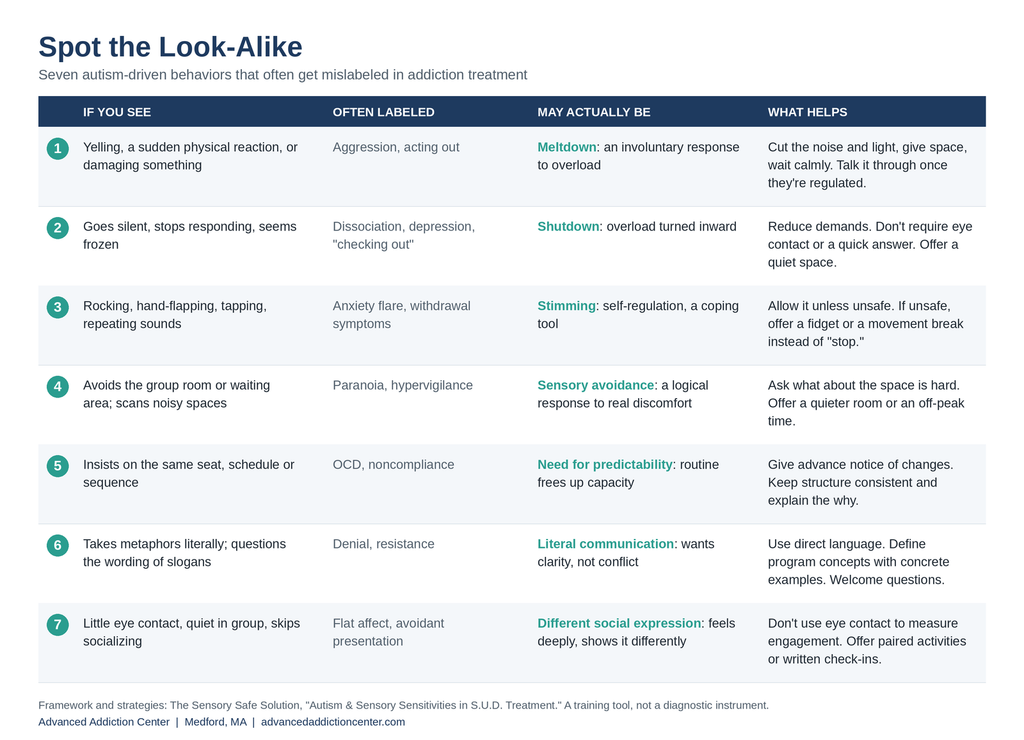
The common thread: behavior has a reason. Before the label goes in the chart, the question is whether this could be sensory or communication.
What early recovery does to an autistic client
This is the part of the training that changes how we read the first few weeks of treatment. If a client has been using substances to manage sensory input, looping thoughts, social effort or executive function, then taking the substance away doesn’t make those traits recede. It makes them show up at full strength. The course puts it bluntly: expect the underlying autism to look stronger in early recovery, not weaker. That isn’t resistance. It’s the coping tool being removed.
Specifically:
- Sensory rebound. After depressants come off, noise, light and touch can feel amplified, and poor sleep lowers tolerance further. Sensory needs tend to peak early, not late.
- Stimming returns. Depressants can suppress it; in early recovery it often comes back or increases. It is easy to mistake for withdrawal agitation.
- Looping thoughts. Often about cravings, a schedule change, a rule, or something that felt unfair. Concrete answers and a set time to talk it through work better than reassurance.
- Blunter communication. Shorter, more literal answers and a flatter affect, which is easy to misread as resistance.
- Fog that outlasts withdrawal. Processing and memory can stay slow for weeks or months, so a client may not retain group content without written reinforcement.
- Masking fatigue. Social anxiety and exhaustion come back, especially in group-heavy programs.
Effects vary by substance, dose and person, and none of this replaces a clinical assessment. But it’s a very different starting assumption than “they’re not engaging.”
What we’re changing
The training is practical, and most of what it asks for costs nothing. Across our day, evening, intensive outpatient and outpatient programs, here is what our staff are putting into practice.
The space. Softer or adjustable lighting in group rooms where we can. Seat choice, including near the door and away from foot traffic. A quieter spot to decompress between groups. A posted schedule, with notice when something changes. Headphones are fine in waiting areas.
How we talk. Short, direct, literal language. Processing time without rushing or repeating. Written or visual backup for verbal instructions. And because we use 12-step programming, explaining the slogans concretely: what “one day at a time” actually asks you to do, not just the phrase. Eye contact is not treated as proof of listening or honesty.
How group runs. An individual or smaller-group option when a full room is too much. Predictable sharing formats, like going around the circle or written prompts, so no one is ambushed. A decompression break after group. With the client’s consent, a brief word to peers about why someone stims or doesn’t make eye contact.
In the moment. If a client melts down or shuts down: lower the voice, reduce the input, give physical space, and wait. It passes on its own timeline. Talk about it afterward, once the person is regulated. What we don’t do is treat it as a behavioral infraction, force eye contact or an explanation, crowd or raise our voice to regain control, or assume intoxication or manipulation.
Noticing, not diagnosing
None of our staff diagnose autism, and this training doesn’t ask them to. As the course puts it, you’re not diagnosing, you’re noticing a pattern. The signs worth noticing are lifelong, not tied to a recent event: a preference for routine and sameness going back to childhood, literal communication across jobs and relationships, sensory reactions in many settings, meltdowns or shutdowns that follow clear triggers, and being exhausted after groups, even ones the person enjoyed.
When that pattern is there, the process is simple: document the sensory triggers, communication needs and routine needs rather than labels like “difficult”; connect the client with a psychologist or specialist experienced in adult autism assessment; and where appropriate, loop in family who may recognize the pattern going back decades.
About The Sensory Safe Solution
The Sensory Safe Solution was founded by Kate Owens-Heins, a salon owner with more than two decades behind the chair and the mother of a son with autism. She spent five years developing a method for sensory-safe haircuts after watching how much a routine appointment could cost an autistic child, then turned that work into a training company in 2023. It has since trained thousands of professionals across the United States and abroad, and the curriculum now extends to behavioral health.
Rocco Danieli, a Massachusetts master barber and founder of Uplift Provisions Co., is bringing the curriculum to treatment programs here in Massachusetts.
What this means for you or your loved one
Nothing about our programs changed on paper. What changed is how prepared our staff are to notice sensory needs and respond to them. In practice:
- Tell us about sensory needs when you call or at intake. Noise, lighting, touch, textures, crowds. We’ll plan around them from day one, and we’ll expect them to be louder in the first few weeks, not quieter.
- Ask for the kind of communication that works for you. More direct, more written down, more time to answer. That’s a reasonable request.
- Ask about seating, quieter options and smaller groups. We’ll do what the space allows.
- If you’ve suspected autism and were never evaluated, say so. We can talk about what a referral would look like alongside your treatment.
Frequently asked questions
Does Advanced Addiction Center have an autism-specific program?
No. Our programs treat substance use disorders and co-occurring mental health conditions. This training helps our staff recognize and support autistic and sensory-sensitive clients within those programs, and refer out when someone needs specialized care we don’t provide.
Is The Sensory Safe Solution training a clinical certification?
It’s a professional development course for staff, not a clinical license or an accreditation. It does not change anyone’s credentials.
I’m autistic and nervous about starting treatment. What should I ask when I call?
Ask how intake works step by step, what the space and group sizes are like, and who you can go to if you’re overwhelmed. Tell us what has helped you in medical or clinical settings before. The more we know going in, the better we can plan.
Get in touch
If you have questions about our programs or want to talk through sensory needs before admission, call (781) 560-6067 or contact us online. You can also verify your insurance in a few minutes.